
Learning from Vienna: How Amsterdam can improve public transport for caregivers
— by Lotte Reijnders, Researcher at Ipsos I&O
Contents
Contents
Women are still primarily responsible for household and caregiving responsibilities, and therefore they are more involved in so-called ‘mobilities of care’: bringing kids to daycare, school, and activities, grocery shopping, accompanying or visiting relatives who need care, and so forth. [1] Also, women on average use public transport to a greater extent compared to men, and this means that they often rely on public transportation for mobilities related to care. [2] Since most cities have been predominantly planned and designed from the male perspective, prioritising mobility related to commuting, care labour has been very much of an afterthought, resulting in the general lack of caregiving infrastructure in cities.
A number of cities, including Vienna, Barcelona, and Umeå, have therefore acknowledged the need for gender-sensitive planning practices to accommodate these needs. In my own city, Amsterdam, attention has only recently been paid to this perspective, which made me wonder if Amsterdam could learn from what has been done in these cities. [3] I decided to investigate it myself by joining mothers in Vienna and Amsterdam while performing their mobilities of care and to examine if the quality of their experiences can be linked to the (lack of) consideration of gender-sensitivity in the cities’ public transport policies and planning. [4] The assumption that mothers in Vienna would have better experiences turned out to be correct. In what follows, I will explain what these more positive experiences of the Viennese mothers can be traced back to.
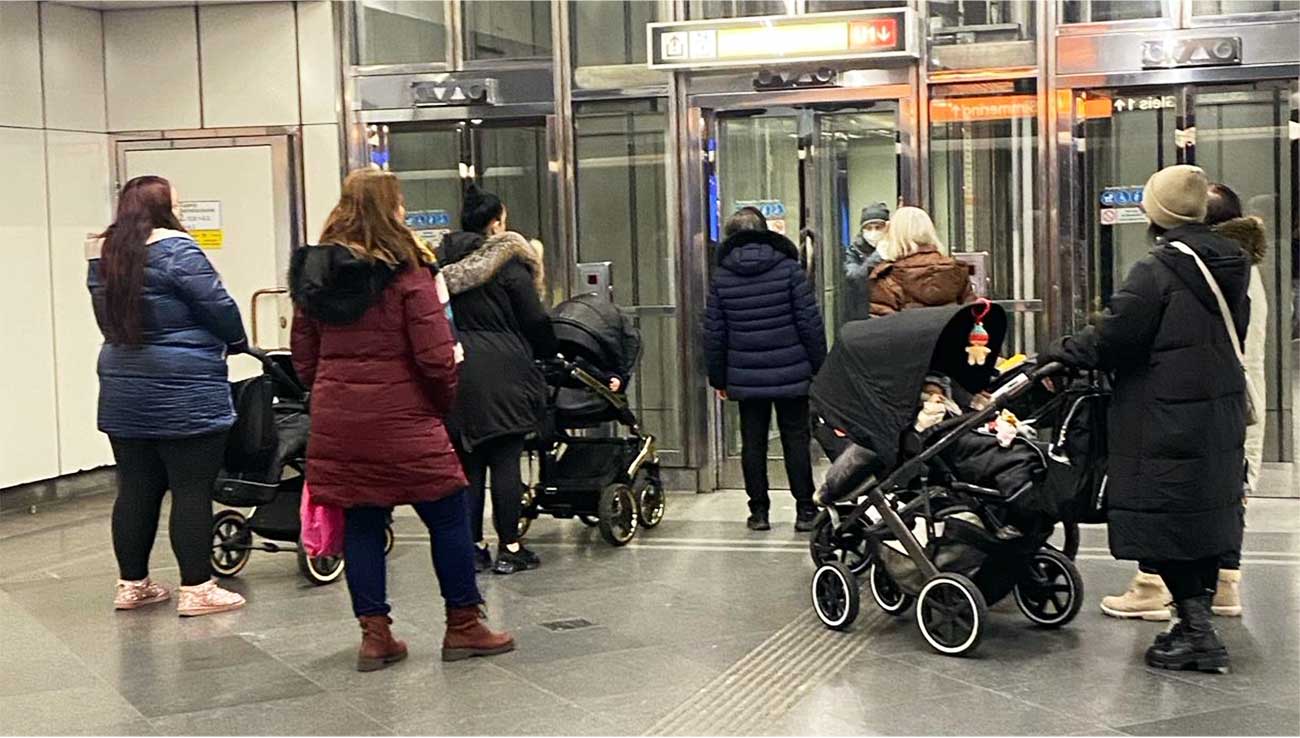
Mothers with prams wait for lifts at one of Vienna's metro stations.
The city of Vienna institutionalized gender mainstreaming
In the 1990’s, it was recognized in the city of Vienna that the female perspective had often been missing. [5] This was particularly true for urban planning as male urban planners created their designs from their own perspective informed by their everyday experiences, which resulted in the neglect of the perspectives of other groups. As a result, gender-sensitive practices were implemented in the city. These gender-sensitive practices prescribe that a gender perspective should be included into the design, implementation, monitoring and evaluation of policies to ensure that the different needs of people of different genders men and women are considered in order to advance gender equality. [6] The city of Vienna defines gender-mainstreaming as follows:
“Gender” refers to a person’s gender role, social or cultural gender, as opposed to biological sex. This means that gender is not only defined through physical characteristics but also through social processes. An example that may serve to illustrate this:
Biological sex determines who can get pregnant. However, biology does not determine who takes care of the children. The question who is responsible for childcare is influenced by “social gender”: Gender roles, stereotypes and assumptions, and gender disparities and discrimination in the labour market lead to inequality, and women are therefore still largely considered to be in charge of childcare.
“Mainstreaming” refers to bringing gender into the mainstream – in this context, it means that gender should be considered everywhere. [7]
Therefore, making adjustments to accommodating the needs of people travelling with children falls under a gender-mainstreaming approach.
In this concept, ‘gender’ embodies the social role associated with being a male or female, which enables examining the impact of social dynamics such as gender roles, stereotypes, biases and inequalities instead of merely physical differences. [8]
Women’s public transport use more often accompanied by children
Employing these principles has increased the understanding of women’s public transport use, which was found to be often accompanied by children as women use public transport to a greater extent to fulfil their mobilities of care, a care task they are still predominantly responsible for. Consequently, they have been distinguished as a separate target group in order to understand their specific needs regarding traveling with children in public transport, and their specific needs have been accommodated for.
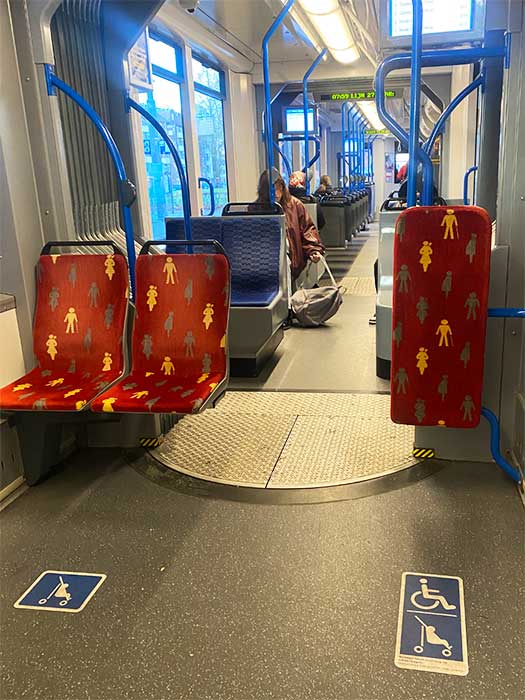
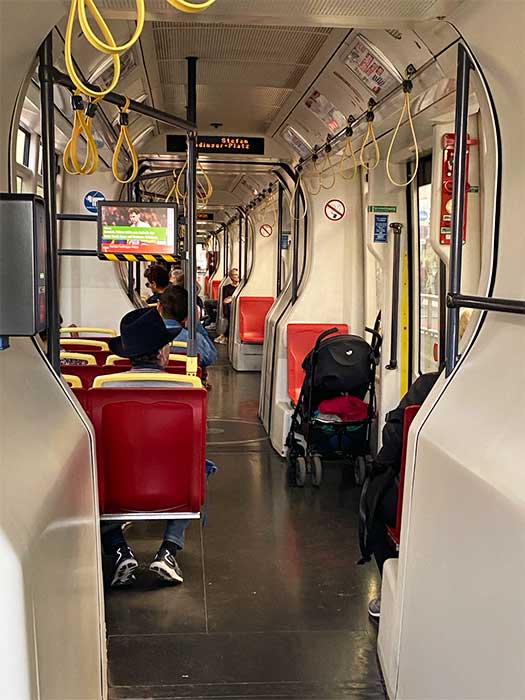
Tram carriages in Amsterdam (left/top) and Vienna.
Public transport is adjusted to the needs of caregivers
As a result, comparing the experiences of mothers in Vienna and Amsterdam, in Vienna multiple factors are identified that ease their mobility while in Amsterdam mothers identify more barriers obstructing their public transport use.
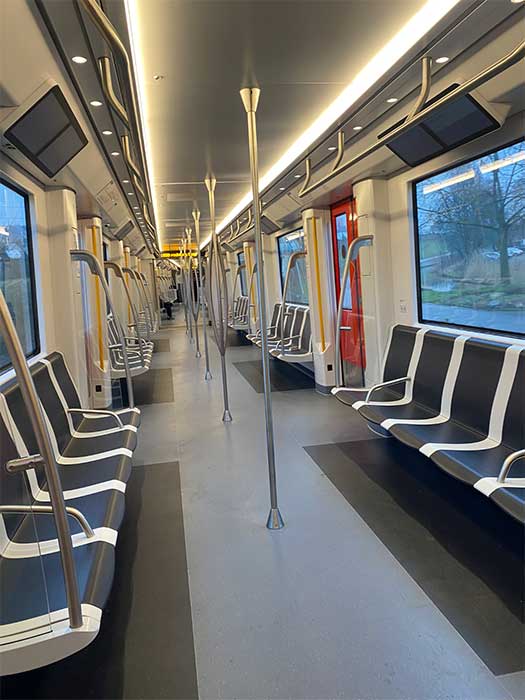
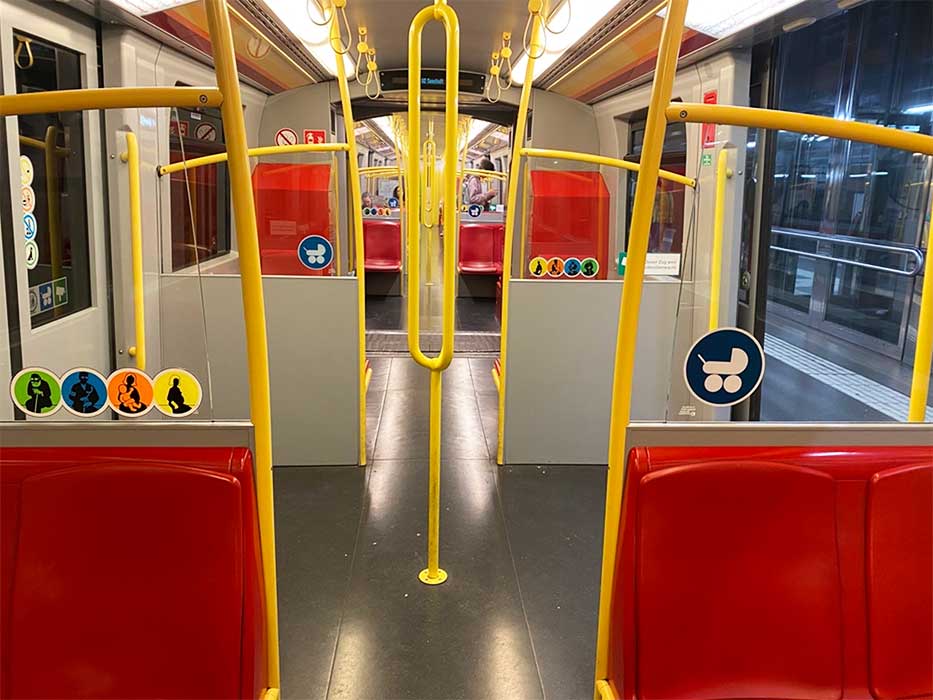
Metro carriages in Amsterdam (left/top) and Vienna.
The inconvenience of a lack of designated places and seats
Most commonly mentioned by the Viennese respondents are the number of places and seats in trams and metros, indicated by priority signs, reserved for caregivers with young children and prams as these enable them to be positioned in a more or less shielded way from other passengers. Thereby, these priority signs can be pointed at when other passengers aren’t aware of occupying these reserved places, this way ‘communicating’ how the space should be used. Furthermore, it’s seen as a form of support as it also ‘communicates’ that caregivers and young children pertain to public transport.
‘As soon as there is a sticker that says ‘it's a special place for a pram’ everyone knows how it works, and they follow it. But if there’s no sticker and you need a place, then you will be ignored. So I think the sticker is really important.’
In Amsterdam, the number of prams allowed on trams is restricted. Especially during crowded rush hours or rainy days, the maximum of two appears to be too restrictive as respondents say they often have to let a vehicle pass in these times. In addition, the fact that public transport policies dictate that wheelchairs are given priority over prams makes it even more likely that access will be denied by a tram conductor.
Due to their lack of designated spaces, the metros don’t have a limited number of prams allowed, causing that access cannot be denied. Nevertheless, the absence of these places means that respondents need to find a suitable spot for their pram themselves, which leads them often being positioned in front of the doors. Especially during rush hours, finding a suitable spot is perceived as challenging, if possible at all:
‘Very often people with prams and wheelchairs stay outside because we're like "we don't want to cram into the metro". These moments you feel a bit rejected like "oh, I cannot travel in rush hour" and then you're more tempted to travel before or after rush hour but that’s not always possible.’
Why accessible stations are essential for caregiving travelers
Accurate information provision seems to facilitate trips further. Viennese respondents appreciate the announcements made in metros about stations’ broken elevators as it enables them to adjust the route in advance. Nevertheless, this rarely happens since the majority of transit stations in Vienna have multiple elevators, ensuring their accessibility. The accessibility of the stations is an aspect highly valued by the Viennese mothers as it makes their trips more reliable and decreases dependency on the help of other people.
This is a great contrast to Amsterdam. Commonly identified as impeding are elevators often being broken for long periods of time. Encountering a broken elevator implies that one needs to use the escalator, which is prohibited, or the stairs, which not all respondents perceive as a suitable option, for example, because they had some negative experiences:
‘Once I arrived at my stop and I saw that the elevator was broken. Ultimately, there was a woman who helped me and together we lifted the pram down. I held my breath to not let my daughter fall because the stairs were really steep. This was such an uncomfortable experience; I wouldn't do this a second time. Next time when I encounter such a situation, I'll go back to another stop.’
Being forced to use the stairs, it’s often unavoidable to ask other people for help as some respondents need to take care of several young children or because they don’t have the physical ability to bring their pram down the stairs. However, this is commonly perceived as undesirable as it creates dependency on the people around. Furthermore, some respondents say they are reluctant to ask for help as they want to avoid putting people in a dangerous situation or because they don’t like strangers coming too close to their children. In these cases, mothers are forced to travel to another stop to exit the metro, resulting in extra travel costs.
Impact of ticket fares
The costs for public transport are further considered as facilitating in Vienna. The cost of 1 euro a day for the unlimited use of public transport, together with the fact that children up to the age of 6 travel for free, ensures that one doesn’t have to think about the costs of each trip, which makes it easier to use this mode of transport multiple times a day.
In Amsterdam, the costs for public transport are arranged differently. Every trip needs to be paid for separately, which makes it more expensive. Almost all the respondents consider public transport in Amsterdam expensive. Furthermore, the fact that children from the age of four need to pay as well makes traveling by public transport even more expensive. In order to save costs, some respondents state they do not always check in their children.
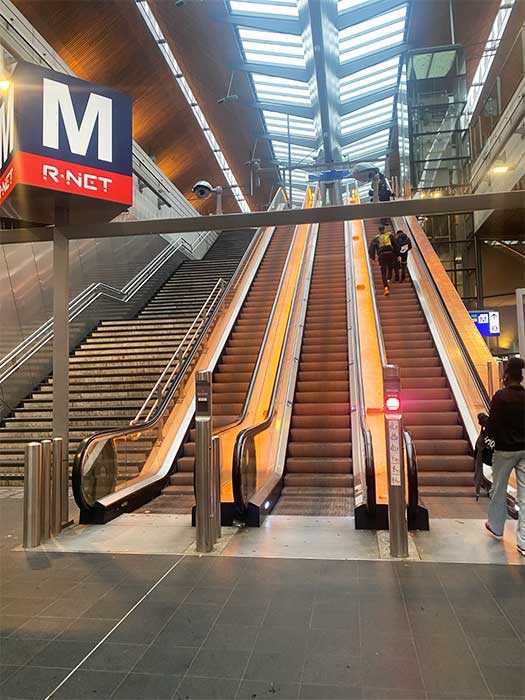
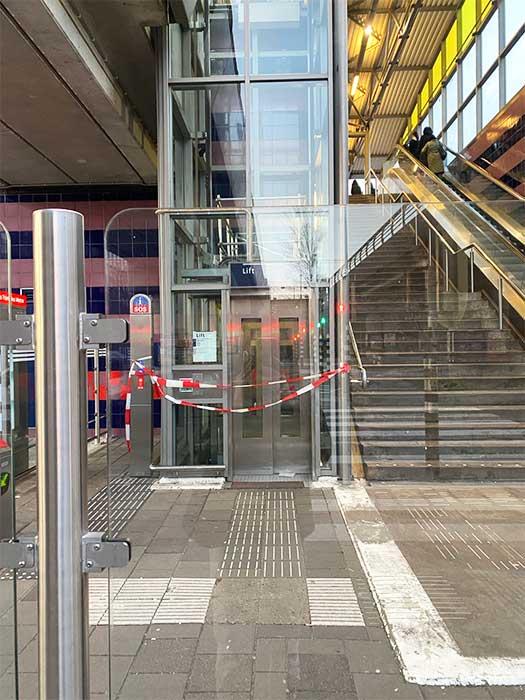
Metro stations in Amsterdam.
Using public transport because it’s convenient or out of necessity?
The design of public transport not only leads to a varying quality of experience but also determines the motive for using public transport. This is evident from the conversations I had with mothers in Vienna and Amsterdam. Comparing their motives to use public transport, Viennese respondents mainly choose to use public transport as it’s considered a convenient mode of transport while respondents in Amsterdam predominantly use it because it’s perceived as their only transport option. This results in more of a ‘voluntary choice’ in Vienna and a ‘forced choice' in Amsterdam.
Perceived constraints in travel choices
This feeling of a forced choice is the result of not having or the inability to use a car and cycling not being an option, which is in great contrast to the respondents in Vienna who don’t perceive cycling as a suitable option to fulfill their daily travels. This can be attributed to the fact that cycling, also with young children, is deeply ingrained in the mobility culture in Amsterdam and is supported by extensive high-quality cycling infrastructure. Although cycling is gaining ground in Vienna as a sustainable mode of transport, it’s not (yet) integrated as a mainstream form of transport, especially not when accompanied by young children, which is generally thought of as dangerous.
Considering cycling as a suitable mode of transport seems to strengthen the Amsterdam respondents' perception of ‘forced choice’ because the inability to cycle and lacking a car causes the feeling of being deprived of two modes of transport, while Viennese respondents who don’t have a car are only deprived of one. This might explain why using public transport feels like the ‘last available option’ while Viennese respondents consider it the ‘other option’.
Extra benefits mentioned in Vienna
Although some Viennese respondents state they are unable to use a car, explained by the same reasons as given in Amsterdam, their choice for public transport still seems to have more positive connotations. This is reflected in additional advantages such as environmental motives and being better able to respond to the child's needs, both in terms of care and entertainment. Given the fact that these advantages aren’t mentioned by respondents in Amsterdam again demonstrates that Viennese respondents are more likely to voluntarily choose public transport, which is in contrast to Amsterdam.
What can we learn from this research?
Long story short, the application of gender-sensitive practices assuring gender-specific data collection, analysis, and policymaking has ensured that the specific needs of caregivers and their young children have been facilitated, resulting in more positive experiences of the Viennese respondents. In contrast, the Amsterdam case demonstrates that overlooking these needs leads to what respondents experience as inadequate facilitation. Therefore, it can be stated that the difference of having institutionalized gender-sensitive practices or not can explain the difference in quality of experience.
Given that the City of Amsterdam is still in an early stage of integrating a gender perspective into urban planning, the city can draw inspiration from the practices and methods applied in Vienna as they have been found to be effective. They especially seem to be effective because they are institutionalized. The main recommendation for Amsterdam, therefore, is to integrate gender-sensitive research methods in the city’s policy domain. Serving these specific needs will not only benefit female caregivers but caregivers in general as traveling with non-able-bodied youth or adults or elderly may cause similar barriers to be experienced.
Steps towards more caregiver-friendly transit in Amsterdam
Applying such methods has already generated some improvements that would be welcomed by the respondents in Amsterdam. Suggested improvements include increasing the number of pram places in trams and buses and realizing separated pram places in metros, a campaign distributed in public transport to make other people and transport employees more aware of the needs of caregivers as well as non-able-bodied and elderly passengers, and lowering the costs for young children. Finally, guaranteeing the working of elevators and escalators to ensure accessibility to stations is perceived as a significant factor that needs to improve. In short, there’s work to be done!

Lotte Reijnders
Lotte Reijnders graduated from the Research Master Urban Studies at the University of Amsterdam in 2024. She is a researcher at Ipsos I&O where she works on issues related to democracy and governance. Though gender-sensitive urban planning practices are not a focus of her work, she is very much involved with the theme of gender-sensitive urban planning and research.
—
Footnotes
1.
Sánchez de Madariaga, I. S., & Zucchini, E. (2019). Measuring mobilities of care, a challenge for transport agendas. In C.L. Scholten & T. Joelsson (eds.), Integrating gender into transport planning: From one to many tracks (pp. 145-173). Palgrave Macmillan. https://doi.org/10.1007/978-3-030-05042-9_7
2.
Most traditional travel surveys worldwide provide data on two genders only.
3.
What I’m referring to are primarily the City of Amsterdam’s engagement with activities of Women Make the City. Though recently the City Council has approved the proposal by Elise Moeskops (D66) ’ ‘Voorstel Gastvrije Openbare Ruimte’ (‘Proposal Welcoming Public Space’) , explicitly focusing on gender, at the time of doing research, this had not yet been discussed by the City of Amsterdam.
4.
This study ‘Mobilities of care in the city: A comparison between mothers’ well-being using public transport in Amsterdam and gender-sensitive Vienna’ (2024) was my thesis research for the Research Master Urban Studies. This study was conducted from September 2023 until June 2024 in Vienna and Amsterdam. Find the study at the following link: Scripties - Bibliotheek - Universiteit van Amsterdam.
5.
Bauer, U. (2009). Gender mainstreaming in Vienna. How the gender perspective can raise the quality of life in a big city. Kvinder, Køn & Forskning, (3-4), 64-70. Irschik, E., Kail, E., Klimmer-Pölleritzer, A., Nuss, A., Puscher, G., Schönfled, M. & Winkler, A. (2013). Manual gender mainstreaming in Urban Development. Urban Development Vienna (MA18) – Urban Development and Planning.
6.
United Nations Women (2014). Gender Mainstreaming in Development Programming. New York: UN Women.
7.
Bauer, U., Führer, P. (MD-OS, Section for Gender Mainstreaming (2021). Gender Mainstreaming - made easy. A manual. MD-OS, Section for Gender Mainstreaming. P.5.
8.
Bauer, U., Führer, P. (MD-OS, Section for Gender Mainstreaming (2021). Gender Mainstreaming - made easy. A manual. MD-OS, Section for Gender Mainstreaming.