
Rethinking mobility planning knowledge: Gendered Mobilities project
— by Anna Nikolaeva & Irene Gómez Varo
"There are no right answers to wrong questions."
Ursula le Guin¹
Being able to move freely, safely, and comfortably is key to people’s well-being and ability to participate equally in society. Yet every day millions of trips are not made because using mobility systems is difficult, dangerous, or impossible for particular social groups. Although many people experience restrictions, discomfort, and even danger when travelling, this project centers gendered mobilities.
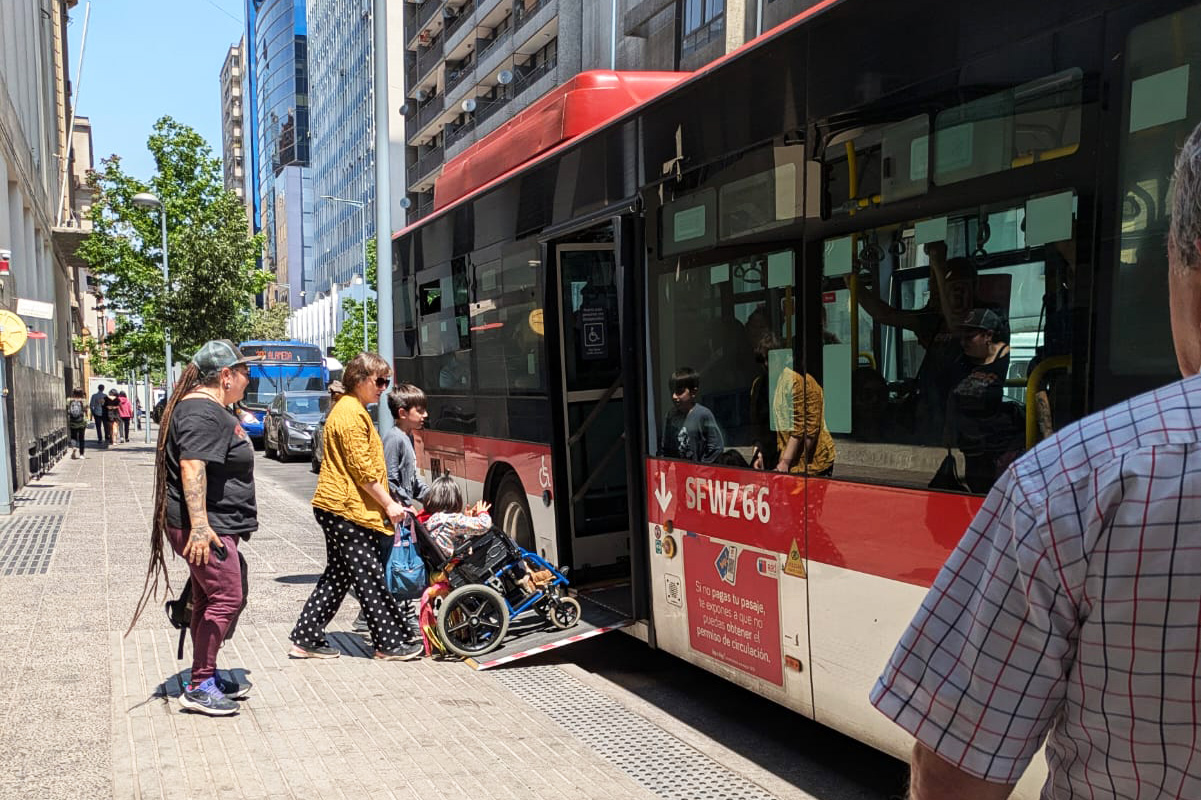
Santiago (Chile). Image by Irene Goméz Varo.
On average, women perform complex mobilities more often than men, travelling between multiple stops rather than proceeding straight to their destinations (Priya Uteng & Turner, 2019). They drive significantly less than men, relying on public transportation, walking, and, in some contexts, cycling (Loukaitou-Sideris, 2020). Yet around the world urban planning prioritises direct travel by car, which is more typical of men (Priya Uteng, 2021). Other types of mobility often receive less investment and are consequently inconvenient, risky, or even impossible. Crucially, harassment significantly impacts women and LGBTQIA+ individuals globally (Lubitow et al., 2020; Moreira & Ceccato, 2021). Exclusion through mobility intersects with other exclusions involving race, ethnicity, caste, income, and disability.

Two women walking in Barcelona. Image by Monica Moreno.
Contemporary urban mobility systems are therefore not gender-neutral, but gender-insensitive. Gendered Mobilities project (2023-2029) starts from the idea that the knowledge underlying urban mobility planning is a key source of this insensitivity. Examples include a lack of gender-disaggregated data, transport research’s overreliance on quantitative methods that obscure lived experiences of marginalised groups, little diversity among transport officers, a neglect of issues that frequently affect women and LGBTQIA+ individuals (e.g. safety on public transport and mobilities with dependent others), lack of interesectional approaches to data analysis, persistent use of gender binary in data collection etc.
The project focuses on three main questions:
How do knowledge production and use practices reproduce gender-insensitivity in planning?
How can these practices be transformed towards greater intersectional gender-sensitivity?
What lessons can be drawn from initiatives in gendered mobility for rendering the mobility issues of other marginalised groups more visible?
In other words, the project seeks to understand: (1) what questions are not asked, what data is not collected, whose voices are ignored; (2) what the consequences of this ignorance, these gaps and omissions are; and (3) how this ignorance can be transcended for broader accessibility in cities.
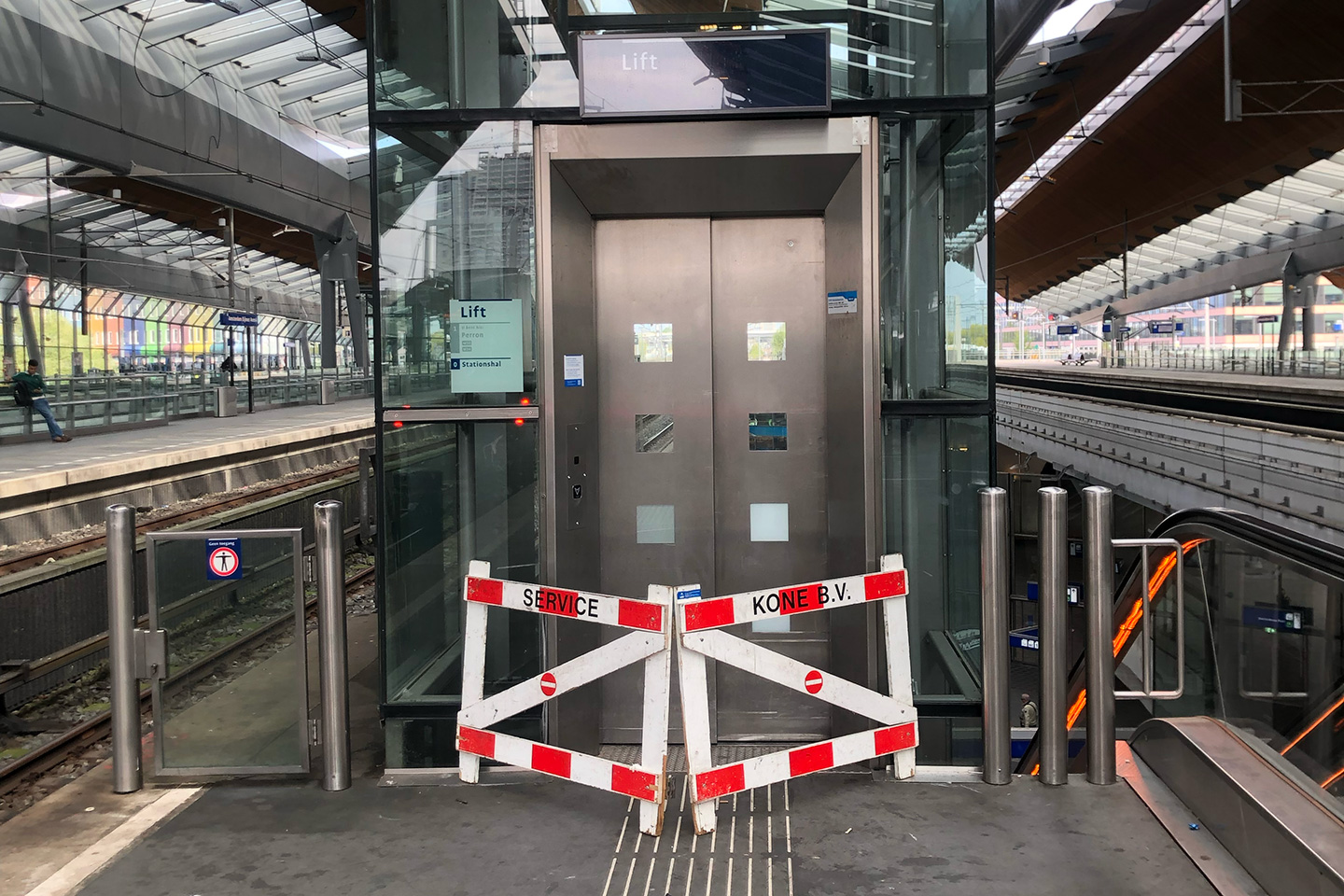
Broken lift at a train station in Amsterdam. Image by Anna Nikolaeva.
The project’s theoretical framework is informed by feminist epistemology, social epistemology and intersectional feminist urban planning. We build on rich scholarship on the subject of gender, mobility and planning and engage with concepts such as interdependency, care, commoning and epistemic justice. You can familiarise yourself with this scholarship and our approach in the paper Moving towards gender-sensitive urban mobility planning: Unpacking the role of knowledge.

Barcelona. Image by Sergi Bernal: www.sergibernal.eu
Our case studies are Amsterdam (the Netherlands), Barcelona (Spain) and Santiago de Chile (Chile). In these three cities Irene Gómez Varo and Anna Nikolaeva have interviewed more than 70 activists, policy-makers, politicians, planners, urban designers and researchers.
This project is led by Anna Nikolaeva, and the project team evolves throughout the years of the project. Our goal is not only to advance academic debate on the subject, but to disseminate the findings among practitioners. We have already presented this work in various non-academic settings and in the nearest future we will start organising events around relevant topics to bring together researchers, students, planners and activists.
We will be sharing the results in various formats on this website, and you can also follow us on LinkedIn to stay up-to-date.

Anna Nikolaeva
Anna Nikolaeva is Assistant Professor at the University of Amsterdam. In her research, writing, teaching and public speaking she engages with a variety of themes in urban planning and human geography, and her current priorities are: nclusive mobilities and the politics of knowledge in planning; gendered mobilities; intersections between low-carbon and just transitions; the role of mobility as social infrastructure of the city; commoning mobility.

Irene Gómez-Varo
Irene Gómez-Varo is a Visiting Scholar at the University of Amsterdam, where she has held a postdoc in 2024-2026 working in the Gendered Mobilities project. In Spring 2026 Irene will start her project “Toward Just and Caring Mobility: Epistemological Tools for the Planning of Care-Full Cities” as a postdoctoral fellow in the Institute of Urban and Territorial Studies of the Pontificia Universidad Católica in Chile. She holds a PhD in Human Geography from the Universitat Autònoma de Barcelona (UAB). Her doctoral work investigated proximity-based environments and daily life dynamics, focusing on mobility and gender. She has been a visiting researcher at Université Pantheon Sorbonne in Paris, the University of Tokyo, and RMIT University in Melbourne. Her academic background includes a BA in Sociology (University of Barcelona) and a Master’s in Population and Territorial Studies (UAB).
—
References
Priya Uteng, T., & Turner, J. (2019). Addressing the Linkages between Gender and Transport in Low- and Middle-Income Countries. Sustainability, 11(17), 4555.
Priya Uteng, T. (2021). Chapter Two—Gender gaps in urban mobility and transport planning. In R. H. M. Pereira & G. Boisjoly (Eds.), Advances in Transport Policy and Planning (Vol. 8, pp. 33–69). Cambridge: Academic Press.
Loukaitou-Sideris, A. (2020). A Gendered View of Mobility and Transport: Next Steps and Future Directions. In Sánchez de Madariaga, I. & Neuman M. (Eds.) Engendering Cities. Designing Sustainable Urban Spaces for all (pp. 19-36). London and New York: Routledge.
Lubitow, A., Abelson, M. J., & Carpenter, E. (2020). Transforming mobility justice: Gendered harassment and violence on transit. Journal of Transport Geography, 82, 102601.
Nikolaeva, A., & Shakthi, S. (2025). Moving towards gender-sensitive urban mobility planning: Unpacking the role of knowledge. Urban Studies, 63(2), 205-224.
Moreira, G. C., & Ceccato, V. A. (2021). Gendered mobility and violence in the São Paulo metro, Brazil. Urban Studies, 58(1), 203–222.
—
Footnotes
1.
Guin, U. K. L. (1979). The Language of the Night: Essays on Fantasy and Science Fiction. Ultramarine Publishing.